Agentic Design Patterns: A Hands-On Guide to Building Intelligent Systems
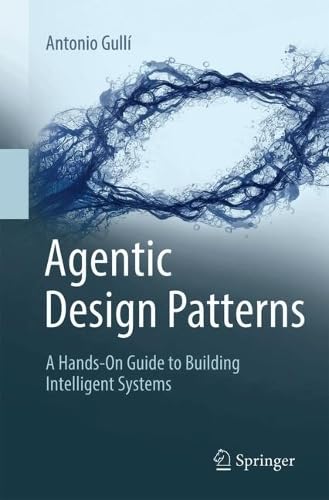
A practical guide presenting 21 design patterns for building AI agents, covering prompt chaining, tool use, multi-agent collaboration, and self-correction techniques with examples in LangChain, CrewAI, and Google ADK.
Core Message
AI agents require structured architectural patterns—not just powerful language models—to move from raw capability to production-ready systems. The 21 design patterns in this book provide reusable, battle-tested blueprints for building agents that perceive, reason, plan, and act autonomously.
Key Insights
- Patterns Over Frameworks - Effective agents need architectural blueprints, not just powerful language models. Design patterns provide the same reusable solutions for AI agents that classic software patterns provide for traditional systems.
- The Four Pillars - The book organizes 21 patterns into four progressive levels: core execution (prompt chaining, routing, parallelization), intelligence and adaptation (memory, learning), reliability and alignment (human-in-the-loop, RAG), and scaling (guardrails, evaluation).
- Prompt Chaining as Foundation - Complex tasks decompose into sequential steps where each step's output feeds the next. This pattern underlies most sophisticated agent behaviors and provides predictable, debuggable workflows.
- Reflection Enables Self-Correction - Agents that evaluate their own outputs, identify errors, and refine iteratively outperform single-pass approaches. Combine reflection with verification tools (unit tests, web searches) for reliable results.
- Multi-Agent Collaboration Mirrors Teams - Distribute tasks across specialized roles (coder, tester, critic) coordinated by a manager agent. Complex problems benefit from the emergent intelligence that arises when specialized agents collaborate.
- Memory Requires Deliberate Design - Separate working memory (immediate context) from long-term memory (accumulated knowledge). Determine what each agent remembers, how memory structures organize, and which retrieval mechanisms apply.
- Routing Optimizes Resources - Direct tasks to the right model or tool based on intent. A math query routes to a calculator; a creative task routes to a powerful LLM. Smart routing balances cost, speed, and capability.
- Human-in-the-Loop Builds Trust - Essential integration points for human judgment handle ethics, creativity, and high-stakes decisions. Autonomous operation works best when humans retain oversight at critical junctures.
- Guardrails Keep Agents Aligned - Safety patterns ensure autonomous operation stays within intended objectives. Production agents need explicit boundaries, content filters, and behavioral constraints.
- Simplicity Beats Complexity - Strive for the simplest effective design. Start single-agent and only move to multi-agent when tasks naturally require distinct prompts, tools, or separable subtasks. Complex agents become impossible to debug.
Notable Quotes
"I think AI agentic workflows will drive massive AI progress this year—perhaps even more than the next generation of foundation models." — Andrew Ng
"Building effective agentic systems requires more than just a powerful language model—it demands structured architectural blueprints." — Antonio Gulli
"The most successful implementations use simple, composable patterns rather than complex frameworks." — Anthropic
Who Should Read This
This book serves AI developers and ML engineers implementing advanced features like multi-step reasoning, memory management, and tool integration. Product managers and tech leads will find concrete patterns to guide development teams from prototype to production. The hands-on code examples in LangChain, CrewAI, and Google ADK make abstract concepts immediately applicable.
Anyone building beyond basic Q&A bots—toward agents that plan, reflect, and collaborate—will benefit from these 21 patterns. The progression from core execution to scaling concerns provides a roadmap for increasing sophistication. No prior agent-building experience required, though familiarity with LLM APIs accelerates implementation.
Overview
This book provides foundational building blocks for constructing AI agents capable of environmental perception, informed decision-making, and autonomous action execution. It covers 21 design patterns progressing from fundamental concepts to advanced techniques.
Topics Covered
- Prompt chaining and tool utilization
- Multi-agent collaboration
- Self-correction techniques
- Hands-on code examples using:
- LangChain with LangGraph
- CrewAI
- Google Agent Developer Kit (ADK)
Connections
Complements 12-factor-agents which provides architectural principles for production-grade agents.